
Automated Messaging Crawler Platform
Automated Messaging Crawler Platform
1,500–2,500
hours
US
location
1,500–2,500
hours
A crawler-based automation system that connects SMS communication with third-party messaging portals, sending and receiving messages through controlled browser automation.
OVERVIEW
We built an automated messaging crawler platform that allows users to send SMS messages while the system handles the complex background process of delivering those messages through third-party web portals.
The platform receives SMS messages, identifies the sender and recipient, fetches all required account and contact information, logs into the needed third-party service through a crawler, finds the correct recipient, sends the message, fetches incoming replies, and returns those replies back to the user through SMS.
This solution is useful when no official API is available and the business still needs a reliable, trackable, and scalable way to automate repetitive web-based messaging workflows.
PROBLEMS WE SOLVED
No official API from third-party services
The required messaging services did not provide a reliable public API for sending and receiving messages.

No official API from third-party services
The required messaging services did not provide a reliable public API for sending and receiving messages.
Manual message delivery was not scalable
Without automation, operators would need to manually log in, search contacts, send messages, check replies, and copy responses back to users.

Manual message delivery was not scalable
Without automation, operators would need to manually log in, search contacts, send messages, check replies, and copy responses back to users.
Complex account and recipient matching
Each message required the system to detect the correct account, recipient, facility, service provider, login credentials, and communication rules.

Complex account and recipient matching
Each message required the system to detect the correct account, recipient, facility, service provider, login credentials, and communication rules.
High risk of delivery errors
Manual workflows could easily lead to sending messages to the wrong recipient, missing replies, or duplicating communication.

High risk of delivery errors
Manual workflows could easily lead to sending messages to the wrong recipient, missing replies, or duplicating communication.
Need for monitoring and recovery
Crawler sessions can fail because of login issues, page changes, validation errors, network instability, or account restrictions.

Need for monitoring and recovery
Crawler sessions can fail because of login issues, page changes, validation errors, network instability, or account restrictions.
Text
Text

Text
Text
Text
Text

Text
Text
Text
Text
Text
Text
PROBLEMS WE
SOLVED
No official API from third-party services
The required messaging services did not provide a reliable public API for sending and receiving messages.
No official API from third-party services
The required messaging services did not provide a reliable public API for sending and receiving messages.
Manual message delivery was not scalable
Without automation, operators would need to manually log in, search contacts, send messages, check replies, and copy responses back to users.
Manual message delivery was not scalable
Without automation, operators would need to manually log in, search contacts, send messages, check replies, and copy responses back to users.
Complex account and recipient matching
Each message required the system to detect the correct account, recipient, facility, service provider, login credentials, and communication rules.
Complex account and recipient matching
Each message required the system to detect the correct account, recipient, facility, service provider, login credentials, and communication rules.
High risk of delivery errors
Manual workflows could easily lead to sending messages to the wrong recipient, missing replies, or duplicating communication.
High risk of delivery errors
Manual workflows could easily lead to sending messages to the wrong recipient, missing replies, or duplicating communication.
Need for monitoring and recovery
Crawler sessions can fail because of login issues, page changes, validation errors, network instability, or account restrictions.
Need for monitoring and recovery
Crawler sessions can fail because of login issues, page changes, validation errors, network instability, or account restrictions.
OUR
SOLUTIONS
SMS-to-crawler messaging pipeline
We created a full message pipeline: user sends SMS → Rails backend receives and validates it → system identifies sender and recipient → job is queued for crawler processing → crawler logs into the required third-party portal → crawler sends the message → delivery result is saved → user receives status updates by SMS.

SMS-to-crawler messaging pipeline
We created a full message pipeline: user sends SMS → Rails backend receives and validates it → system identifies sender and recipient → job is queued for crawler processing → crawler logs into the required third-party portal → crawler sends the message → delivery result is saved → user receives status updates by SMS.
Incoming message fetching
Crawler workers regularly check third-party portals for new incoming messages, fetch them, normalize the content, save them in the Rails backend, and send them back to users via SMS.

Incoming message fetching
Crawler workers regularly check third-party portals for new incoming messages, fetch them, normalize the content, save them in the Rails backend, and send them back to users via SMS.
Browser automation layer
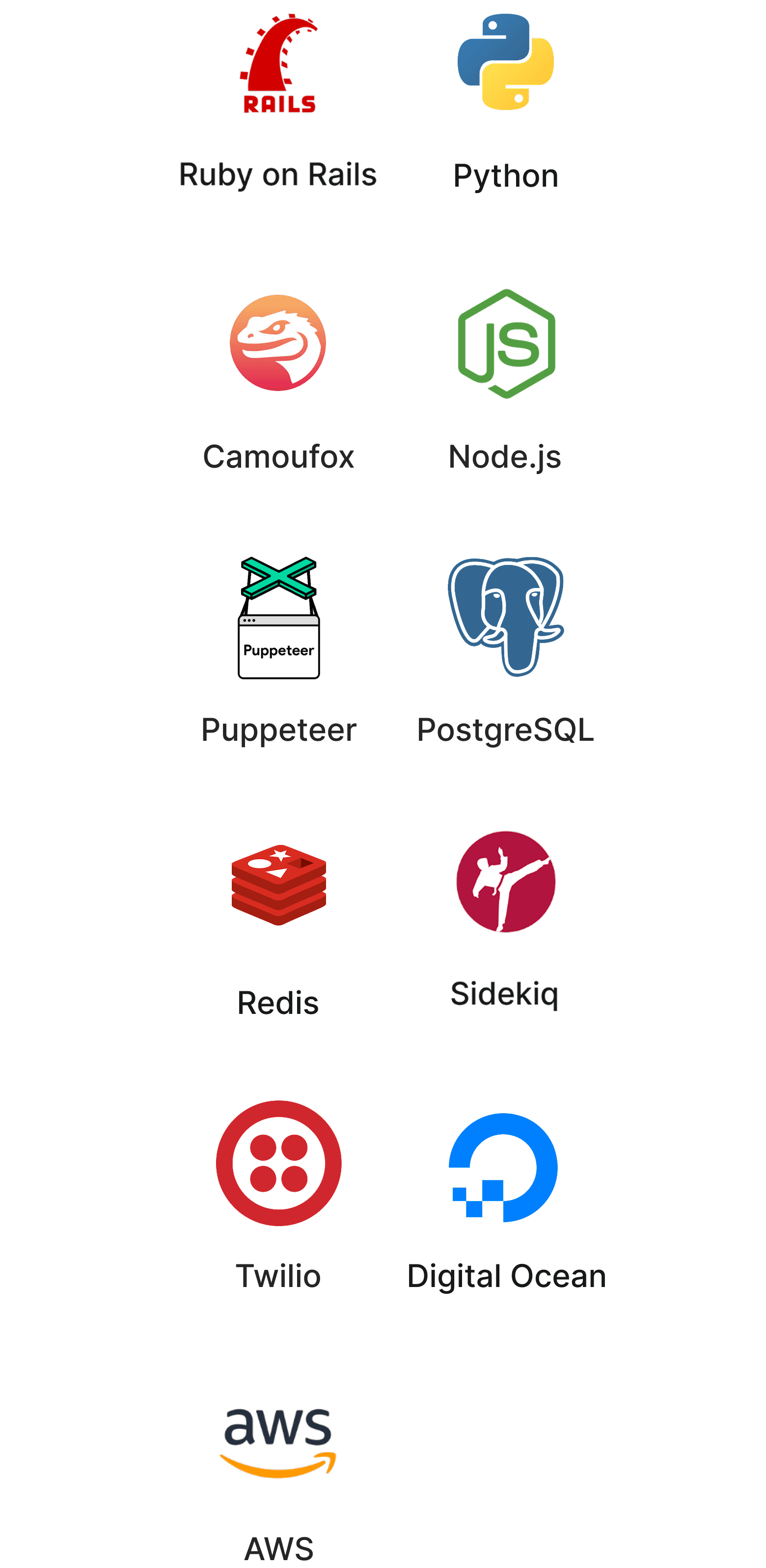
We implemented crawler automation using Python, Camoufox, Node.js, Puppeteer, background workers, session management and proxy-aware browser configuration.

Browser automation layer
We implemented crawler automation using Python, Camoufox, Node.js, Puppeteer, background workers, session management and proxy-aware browser configuration.
Account and contact matching logic
The backend handles: user identification, contact matching, account assignment, service provider detection, facility-specific rules, duplicate prevention and message threading.

Account and contact matching logic
The backend handles: user identification, contact matching, account assignment, service provider detection, facility-specific rules, duplicate prevention and message threading.
Queue-based processing
We used background jobs to process messages safely and asynchronously: message sending jobs, incoming message fetching jobs, retry jobs, failed login jobs, account health checks and notification jobs.

Queue-based processing
We used background jobs to process messages safely and asynchronously: message sending jobs, incoming message fetching jobs, retry jobs, failed login jobs, account health checks and notification jobs.
Error handling and recovery
The system detects and handles login failures, blocked accounts, invalid recipients, missing fields, page structure changes, network errors, duplicate submissions and message delivery failures.

Error handling and recovery
The system detects and handles login failures, blocked accounts, invalid recipients, missing fields, page structure changes, network errors, duplicate submissions and message delivery failures.
Admin monitoring dashboard
Admins can review crawler status, message queue, failed jobs, account health, delivery history, incoming replies, logs and screenshots, retry attempts.

Admin monitoring dashboard
Admins can review crawler status, message queue, failed jobs, account health, delivery history, incoming replies, logs and screenshots, retry attempts.

OVERVIEW
We built an automated messaging crawler platform that allows users to send SMS messages while the system handles the complex background process of delivering those messages through third-party web portals.
The platform receives SMS messages, identifies the sender and recipient, fetches all required account and contact information, logs into the needed third-party service through a crawler, finds the correct recipient, sends the message, fetches incoming replies, and returns those replies back to the user through SMS.
This solution is useful when no official API is available and the business still needs a reliable, trackable, and scalable way to automate repetitive web-based messaging workflows.
OUR SOLUTIONS
SMS-to-crawler messaging pipeline
We created a full message pipeline: user sends SMS → Rails backend receives and validates it → system identifies sender and recipient → job is queued for crawler processing → crawler logs into the required third-party portal → crawler sends the message → delivery result is saved → user receives status updates by SMS.
SMS-to-crawler messaging pipeline
We created a full message pipeline: user sends SMS → Rails backend receives and validates it → system identifies sender and recipient → job is queued for crawler processing → crawler logs into the required third-party portal → crawler sends the message → delivery result is saved → user receives status updates by SMS.
Incoming message fetching
Crawler workers regularly check third-party portals for new incoming messages, fetch them, normalize the content, save them in the Rails backend, and send them back to users via SMS.
Incoming message fetching
Crawler workers regularly check third-party portals for new incoming messages, fetch them, normalize the content, save them in the Rails backend, and send them back to users via SMS.
Browser automation layer
We implemented crawler automation using Python, Camoufox, Node.js, Puppeteer, background workers, session management and proxy-aware browser configuration.
Browser automation layer
We implemented crawler automation using Python, Camoufox, Node.js, Puppeteer, background workers, session management and proxy-aware browser configuration.
Account and contact matching logic
The backend handles: user identification, contact matching, account assignment, service provider detection, facility-specific rules, duplicate prevention and message threading.
Account and contact matching logic
The backend handles: user identification, contact matching, account assignment, service provider detection, facility-specific rules, duplicate prevention and message threading.
Queue-based processing
We used background jobs to process messages safely and asynchronously: message sending jobs, incoming message fetching jobs, retry jobs, failed login jobs, account health checks and notification jobs.
Queue-based processing
We used background jobs to process messages safely and asynchronously: message sending jobs, incoming message fetching jobs, retry jobs, failed login jobs, account health checks and notification jobs.
Error handling and recovery
The system detects and handles login failures, blocked accounts, invalid recipients, missing fields, page structure changes, network errors, duplicate submissions and message delivery failures.
Error handling and recovery
The system detects and handles login failures, blocked accounts, invalid recipients, missing fields, page structure changes, network errors, duplicate submissions and message delivery failures.
Admin monitoring dashboard
Admins can review crawler status, message queue, failed jobs, account health, delivery history, incoming replies, logs and screenshots, retry attempts.
Admin monitoring dashboard
Admins can review crawler status, message queue, failed jobs, account health, delivery history, incoming replies, logs and screenshots, retry attempts.
Text
Text
Text
Text
PROBLEMS WE SOLVED
No official API from third-party services
The required messaging services did not provide a reliable public API for sending and receiving messages.
Manual message delivery was not scalable
Without automation, operators would need to manually log in, search contacts, send messages, check replies, and copy responses back to users.
Complex account and recipient matching
Each message required the system to detect the correct account, recipient, facility, service provider, login credentials, and communication rules.
High risk of delivery errors
Manual workflows could easily lead to sending messages to the wrong recipient, missing replies, or duplicating communication.
Need for monitoring and recovery
Crawler sessions can fail because of login issues, page changes, validation errors, network instability, or account restrictions.
Text
Text
Text
Text
Text
Text
OUR SOLUTIONS
SMS-to-crawler messaging pipeline
We created a full message pipeline: user sends SMS → Rails backend receives and validates it → system identifies sender and recipient → job is queued for crawler processing → crawler logs into the required third-party portal → crawler sends the message → delivery result is saved → user receives status updates by SMS.
Incoming message fetching
Crawler workers regularly check third-party portals for new incoming messages, fetch them, normalize the content, save them in the Rails backend, and send them back to users via SMS.
Browser automation layer
We implemented crawler automation using Python, Camoufox, Node.js, Puppeteer, background workers, session management and proxy-aware browser configuration.
Account and contact matching logic
The backend handles: user identification, contact matching, account assignment, service provider detection, facility-specific rules, duplicate prevention and message threading.
Queue-based processing
We used background jobs to process messages safely and asynchronously: message sending jobs, incoming message fetching jobs, retry jobs, failed login jobs, account health checks and notification jobs.
Error handling and recovery
The system detects and handles login failures, blocked accounts, invalid recipients, missing fields, page structure changes, network errors, duplicate submissions and message delivery failures.
Admin monitoring dashboard
Admins can review crawler status, message queue, failed jobs, account health, delivery history, incoming replies, logs and screenshots, retry attempts.
Text
Text
RESULTS
RESULTS
Automated end-to-end message delivery. Users can send SMS messages while the system performs all third-party portal actions automatically.
Reduced manual support work. Operators no longer need to manually copy messages between SMS and web portals.
Better delivery traceability. Every outgoing and incoming message has status history, logs, timestamps, and processing details.
More reliable communication flow. Retries, validations, and error handling reduce missed messages and duplicate sends.
Scalable crawler architecture. New third-party portals, facilities, and message workflows can be added using the same backend/crawler foundation.
TECH STACK

TECH STACK
DISCOVER OTHER
PROJECTS
DISCOVER OTHER
PROJECTS






Got an idea or a question?
Leave your contact details - we’ll get in touch, answer your questions, and help make your idea happen.
Got an idea or a question?
Leave your contact details - we’ll get in touch, answer your questions, and help make your idea happen.
Got an idea
or a question?
Leave your contact details - we’ll get in touch, answer your questions, and help make your idea happen.
Your brand must be secure. Let’s build it right.
2026©All rights reserved.
Your brand must be secure. Let’s build it right.
2026©All rights reserved.
Your brand must be secure. Let’s build it right.
2026©All rights reserved.